
The Hidden Role of Tufnol in Cracking the Enigma Code
Did you know? Tufnol played a role in one of the most important technological breakthroughs of the Second World War, helping to crack the infamous Enigma code.
The Enigma
During WWII, the German military relied heavily on the Enigma machine to secure its communications. This sophisticated encryption device generated an almost unimaginable level of complexity, with more than 158 quintillion possible settings, changing daily.
To German forces, it was effectively unbreakable.
But the story of Enigma’s defeat began earlier than many realise.
The Foundations of Codebreaking
In 1932, a team of Polish mathematicians achieved what seemed impossible: they reverse-engineered the internal wiring of the Enigma machine using advanced mathematical techniques. Their work laid the foundation for future breakthroughs.
Just weeks before the invasion of Poland in 1939, these researchers shared their findings and an early electromechanical decoding device, known as the Bomba, with British intelligence. This act of collaboration proved pivotal.

Bletchley Park and the Challenge of Scale
At Bletchley Park, Britain’s codebreaking hub during World War II, cryptologists faced a daunting reality. Even with the Polish insights, the scale of the challenge was immense. Testing all possible Enigma settings by hand was simply not feasible.
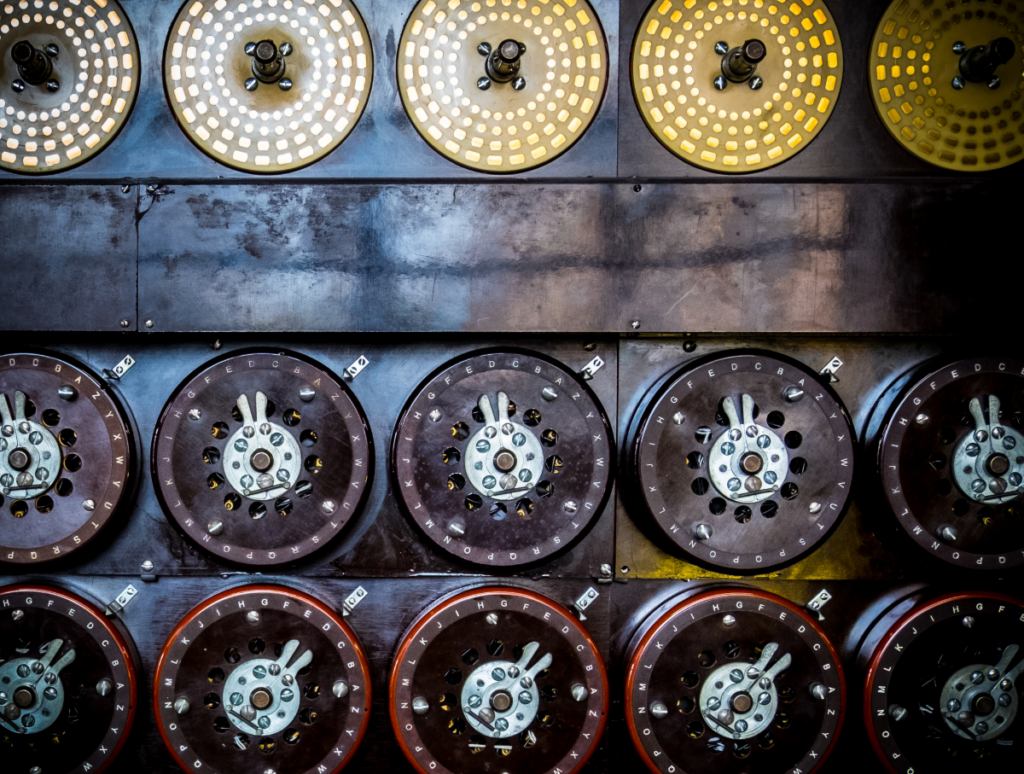
The solution came in the form of industrial innovation: the Turing-Welchman Bombe.
Designed by Alan Turing in 1939 and with important contributions from Gordon Welchman, , the Bombe worked by systematically eliminating impossible combinations, rather than directly decrypting messages.
It rapidly tested thousands of potential Enigma configurations every minute, searching for logical contradictions. By narrowing the possibilities, it transformed an otherwise unsolvable problem into one that could be cracked consistently and efficiently.
Rather than directly decrypting messages, the Bombe worked by systematically eliminating impossible combinations. It rapidly tested thousands of potential Enigma configurations every minute, searching for logical contradictions and allowing codebreakers to decipher thousands of intercepted messages daily. By narrowing the possibilities, it transformed an otherwise impossible problem into a solvable one.
Engineering Precision: Where Materials Mattered
The Bombe was a remarkable feat of engineering. It relied on:
- High-speed rotating drums
- Dense arrays of electrical contacts
- Vast and complex circuitry operating continuously
For such a machine to function reliably, one requirement stood above all others: absolute control of electricity.
There could be no leakage, no interference, and no margin for failure. Even the smallest electrical fault had the potential to halt operations entirely.
The Role of Tufnol
This is where Tufnol quietly played its part.
Used throughout the Bombe’s construction, Tufnol provided a combination of properties that were essential to the machine’s performance:
- Exceptional electrical insulation – preventing short circuits across intricate contact systems
- Dimensional stability and strength – ensuring rotating components remained precisely aligned at high speeds
- Excellent machinability – allowing complex, high-precision parts to be manufactured reliably at scale
In such a demanding environment, these characteristics were not just beneficial, they were critical.
A Legacy That Endures
While the Bombe itself has become a symbol of wartime ingenuity, it’s important to recognise the materials that made its operation possible. Tufnol’s contribution may have been understated, but it was fundamental to ensuring the reliability and precision the system demanded.
Nearly 90 years later, that role hasn’t changed.
Today, Tufnol continues to be trusted in applications where failure simply isn’t an option. Its proven combination of insulation, durability, and stability makes it a reliable choice for modern engineering challenges, particularly in demanding electrical environments.
From helping to crack one of history’s most complex codes to supporting today’s high-performance systems, Tufnol demonstrates a timeless truth:
Even the smallest components can make the biggest difference.
Discover more about how Tufnol performs in modern electrical applications: